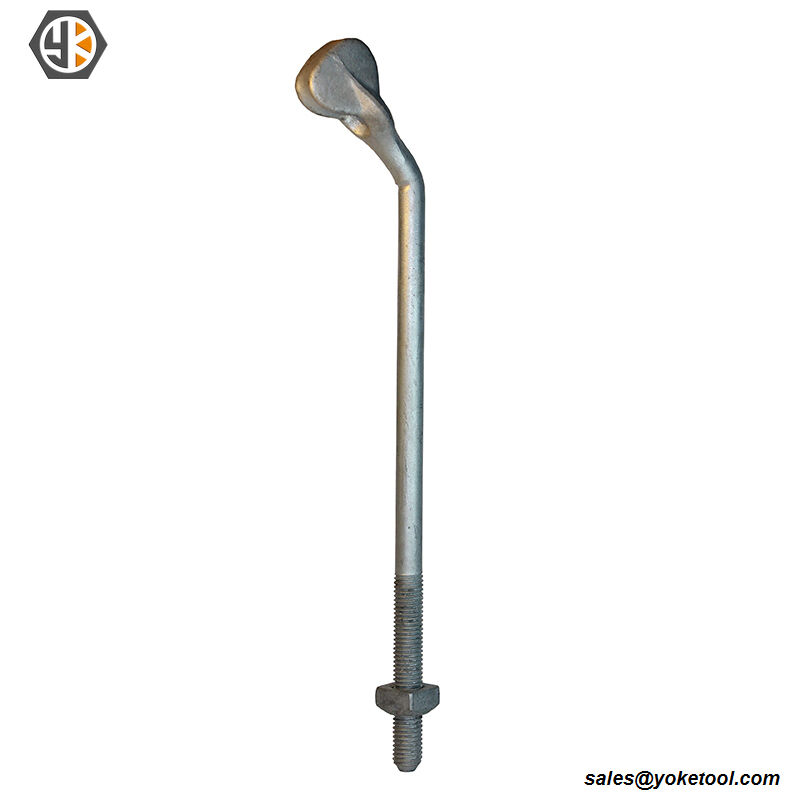
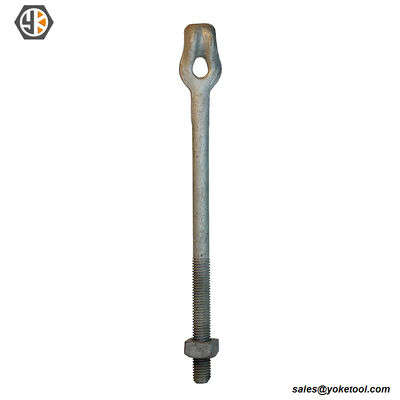
Applications of Thimbleye, Twineye, and Tripleye Guy Anchor Rods
The three types of guy anchor rods—Thimbleye, Twineye, and Tripleye—play a crucial role in providing stable support for power and communication infrastructure, with their application scenarios clearly differentiated based on the specific needs of different facilities. In power distribution lines, Thimbleye guy anchor rods are the core choice for standard configurations. They deliver reliable fixation for power distribution poles, directly ensuring the stability of power transmission and thus guaranteeing the continuous supply of electricity for residential and commercial use. For transmission towers, which feature more complex structures and bear greater stress, Twineye and Tripleye guy anchor rods take the lead. With their superior load-bearing and stress-resistant capabilities, these two types effectively handle the substantial weight of transmission towers while withstanding external impacts from harsh environmental factors such as strong winds and heavy rainfall, safeguarding the safety of long-distance high-voltage power transmission.
In the field of communication towers, all three types of guy anchor rods together form the "stable foundation" of the infrastructure. Whether for signal transmission towers or microwave communication towers, they can provide uniform and long-lasting support for the tower structure in complex terrains (such as mountainous areas and coastal regions) or extreme weather conditions. This ensures the stable transmission of communication signals and prevents communication disruptions caused by tower swaying or displacement.
Tips for Working with Thimbleye, Twineye, and Tripleye Guy Anchor Rods Effectively
When do we say an guy anchor rod is effective? This is so when the rod is able to hold a guy wire firmly into the foundation so that it can support the pole line. Here are some of the key factors that can help you get the best out of your guy anchor rod.
1. Mechanical Expansion Anchors
This operation mode is based on the force of friction. It keeps in mind the fact that a transfer of frictional force causes an expansion force to interlock with the anchor rod. This exchange of forces ins further divided into displacement controlled mechanical anchors and torque-controlled anchors.
2. Undercut anchors
This mechanism is derived from the fact that the force which is transferred to the interlock heavily depends on the mechanical interlock. In the process of drilling a concrete, a contact surface is created between the wall of the holes and the anchor head. This results to an exchange of the bearing stress hence making the anchor rod to be more effective.
3. Screw Anchors
The mechanism that is used here will depend on the pressure that is exerted between the concrete band the screw pitches.
4. Bonded Anchor
This mechanism usually works perfectly when bonded stress is made of organic material. In this case, threaded rods and ribbed bars tend to form adhesive anchors for the fastener.
5. Powder actuated anchor
This mechanism of anchor rod works through the transfer of force through the mechanical interlocks. It is commonly used for the steel-steel connection.
Yokelink - Thimble Eye / Twin Eye / Triple Eye Poleline Guy Anchor Rods Manufacturer in China